
In an essay that I posted here just over a year ago, Terminal Capitalism: The new era heralded by Trump’s second term, I argued that the second Donald Trump presidency signalled the end of what has been called late stage capitalism and the beginning of a new era best labelled terminal capitalism. I listed three shifts as core elements of the new economic phase: the institutionalization of plutocracy, the official embrace of cryptocurrency, and the dissociation between liberalism and capitalism. Now, after the many tumultuous geopolitical events of 2025 and the first six weeks of 2026, I’d like to consider how these three shifts and my declaration of terminal capitalism have fared.
The Embrace of Cryptocurrency
Let me start with the embrace of cryptocurrency. Last year, I claimed that crypto would integrate increasingly with traditional finance, marking our entry into a new phase of capitalism. This prediction has so far been entirely borne out.
Although Trump had expressed bombastic skepticism about cryptocurrency in his first term, saying it was “based on thin air,” the crypto bro lobby bought his support by donating more to his 2024 election campaign than the oil and gas industry, while his progeny convinced him of the opportunity to profit himself.1 In fall of 2024, Eric and Don Jr. established World Liberty Financial (WLF), ostensibly as a chartered bank for crypto assets (though it has served in practice as a mechanism for collecting Trump family bribes). Early in 2025, Trump also launched his own meme coin, using the aura of the presidency to reap hundreds of millions in profit. All told, Trump and his sons are thought to have already made billions of dollars from involvement in crypto enterprises, dwarfing the profits from all other family businesses including their hotels and golf clubs.
The direct participation of the president of the world’s largest economy in the cryptocurrency industry has granted it symbolic legitimacy like almost nothing else could have.2 But this was merely a prelude to official recognition and even active promotion by the government. The White House’s first move was to eliminate nearly all oversight for the industry in the first half of 2025. Under it’s influence, the Security and Exchange Commission (SEC) dropped lawsuits or dismissed charges against a string of crooked crypto corporations and alleged criminals, while the Department of Justice disbanded its unit responsible for regulating crypto-crime. This approach amounted to effectively abandoning enforcement of existing rules, regulations, and laws. It was soon followed by active deregulation, through the withdrawal of past guidance that had blocked financial institutions from engaging with crypto, and with the passage of pro-crypto regulation such as the GENIUS Act that is now helping facilitate such engagement. Meanwhile, the Treasury began to stockpile bitcoin and other crypto assets as part of a so-called strategic reserve, thereby staking public money on high risk assets to inflate the value of cryptocurrency for private investors such as the Trump family.
The upshot of all this is that North America is now the number one region for blockchain transactions valued at ten million dollars or more; in other words, it has become the home of institutional scale crypto. So in little over a year, Trump has already succeeded in his stated goal of making America the “crypto capital of the planet” and melding the cryptosphere with the financial sphere, all while increasing his family’s fortune to the tune of billions.
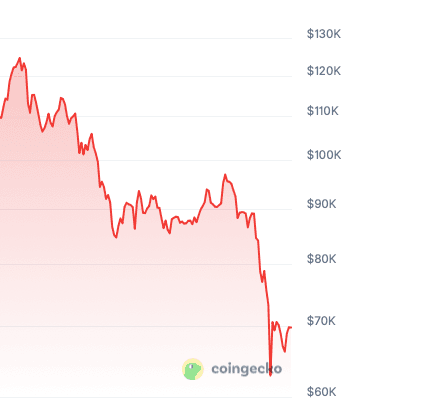
At time of writing, we are in the middle of a cryptocurrency crash, with the value of Bitcoin plummeting from its all-time peak in October 2025 to half that value and the market cap for global cryptocurrency as a whole dropping by two trillion dollars in just three months. Therefore, the prospects for this financial revolution are somewhat uncertain in the short term. But there is no question that the foundation has already been laid for it to proceed apace over the long term. Without some sort of government intervention, the symbolic legitimacy, enforcement laxity, regulatory support, public investment, and nepotistic incentives are set to ensure acceleration of financial cryptofication in the world’s largest market, providing a base of official sanction and entrenchement from which crypto can continue its transnational expansion.3
The Dissociation of Liberalism and Capitalism
Let’s now consider the dissociation of liberalism and capitalism. This is another trend that I claimed in my essay last year was a component of terminal stage capitalism. Like the cryptofication of finance, it has progressed rapidly over the past year, far more rapidly, in fact, than I or almost anyone could have anticipated.
The USA’s descent into authoritarianism began with a swift and decisive power grab. I predicted correctly that the Trump-stacked supreme court, after effectively granting him impunity for all crimes, would allow the White House to run rough-shod over other branches of the state apparatus. What I did not expect was that Congress would effectively cede all its power to the president, that Democrats would repeatedly relinquish their leverage, as when they ended the government shutdown despite broad support from the public, nor that universities, law firms, and other supposed bastions of democratic civil society would acquiesce so quickly and submissively.
The political power concentrated in the executive branch due to the near total failure of constitutional checks and balances is now bolstered by a domestic military force under direct command of the White House. This force was established through federalization of the National Guard and transformation of Immigrations and Customs Enforcement (ICE) into an effective paramilitary force with an almost unlimited budget, larger than that of all other US law enforcement agencies combined.
The above consolidation of power was itself a significant assault on liberalism, requiring countless violations of norms, laws, and constitutional principles. But the Trump administration’s further abuses of human rights and other liberal principles that it committed through exercise of this ill-begotten power are too numerous to even begin to summarize. The establishment of overseas gulags, the refusal to use funds appropriated by Congress, the murder of the shipwrecked in violation of rules of war, the coldblooded execution of American citizens on the streets… All the while American GDP has continued to grow at a steady clip and the stock market has stretched from high to high. Never has liberalism seemed more irrelevant to the flourishing of markets.
There is some uncertainty as to whether liberalism and capitalism will continue their cataclysmic breakup in America given that pockets of resistance have begun to form against the White House. Some universities, beginning with Harvard, are refusing to submit to federal pressure. Millions have mobilized for the No Kings protests. Such acts of defiance have picked up since an ICE agent publicly murdered Renee Good in early January. The city of Minneapolis has emerged as a kernel of resistance. On the national level, support for Trump’s approach to immigration has dropped somewhat. Recently, the National Guard has been withdrawn from some though not all cities. A few Republican lawmakers have even voted against Trump’s tariffs. Many Democratically aligned Americans are placing hope in this fall’s Midterm elections, in which the Republicans are predicted to lose. This, they believe, will begin to restore some semblance of sanity to the republic.
Europe is also finally signs of having a backbone vis-a-vis Trump. After spending all of 2025 neglecting to meaningfully sanction or even criticize America’s swing toward what can only be called fascism, for fear of compromising US military support for Ukraine, the EU seems to have finally been galvanized into crisis mode by Trump’s previous threat to militarily seize Greenland. Although Europe condemned itself to geopolitical irrelevancy throughout most of 2025, this year may show the fractured dithering bloc engaging in some long overdue pushback.
However, there are reasons to doubt that either national or international resistance will significantly halt or reverse America’s eschewing of liberalism. Given Trump’s record of denying valid election results and supporting violent insurrection against Congress, it seems unlikely that a democratic result will be honoured by his White House, especially with the enormous political power it continues to amass. Even if the result is honoured, the few counter measures available to Congress seem woefully inadequate. It could try to impeach the president yet again, which had no lasting effect even on the two occasions it succeeded. Or perhaps it could force yet another government shutdown, which Democrats lacked the guts to follow through on previously. With the Supreme Court ready to back the president in nearly all his actions, however blatantly in conflict with any reasonable conception of law, it is not clear whether Congress retains enough leverage to hinder the executive branch.
Ultimately, the fate of the American political system and waning empire may come down to which side has a greater capacity to deploy physical violence. Without a countervailing military force to resist the federalized National Guard and surging paramilitary might of ICE—not to mention the heavily armed MAGA citizen militias —the people seem to lack any obvious mechanism to rein in the Trump administration. With an appropriate conspiracy theory pretext (a woke mob attempting an insurrection in cahoots with elite pedophiles and fentanyl smugglers?), an American Tiananmen Square moment seems far from unlikely.
But even supposing the Trump administration can be brought to heel by a Democratically controlled Congress or some other constellation of resistance, there is little reason to believe that this would reverse the collapse of federal liberal institutions. This is not to say that liberal democracy will remain forever out of reach in the USA. I remain optimistic that the fierce, proud, freedom-loving people of the United States of America will one day muddle their way toward a new and better democratic system. My point is only that liberal democracy is not likely to be rejuvenated through either legislation or elections any time soon.
So as with the cryptification of finance, some uncertainty remains, but the ongoing dissociation of liberalism and capitalism in the USA appears set to proceed for the time being. The sum effect of America’s fascist turn and Europe’s bumbling representation of the liberal status quo is to make China, a society that has realized a historically unprecedented synthesis of hyper capitalism and hyper authoritarianism, appear virtuous and capable by comparison. Without a global superpower or bloc that demonstrates both adherence to human rights and competence, the alternative bargain that China offers—industrial and technological excellence in exchange for domination and oppression by the party—will come to appear increasingly attractive to many. In other words, America’s fascist descent lends itself to the threat of not just a global rift between capitalism and liberalism but a preference for the former completely bereft of the latter.
The Open Institutionalization of Plutocracy
The third shift that I claimed in my essay last year heralded the terminal capitalist phase was what I called the institutionalization of plutocracy. My main example of this was the then newly established Department of Government Efficiency (DOGE). While various moneyed interests such as transnational corporations and wealthy oligarchs have influenced politics in the USA and elsewhere for decades, diluting the voice of the people with well-funded lobbying, it seemed unprecedented for a billionaire to be officially transformed into an organ of the state.
Since Musk and Trump rapidly fell out as I predicted, however, it is unclear how relevant DOGE is anymore. Although it initially allowed to Musk to vent his apparent hatred for public institutions in a ketamine-fuelled frenzy and to wreak severe damage on various components of the American bureaucratic apparatus through a series of sporadic and capricious firings, failing to reduce government spending by more than a negligible amount, DOGE has been quiet for months. Therefore, it is not currently clear whether its sudden emergence at the end of 2024 marked so significant a break with late stage capitalism as I claimed.
However, the jury is still out on what historical influence DOGE might have going forward. DOGE itself could be reinvigorated or another public plutocratic institution might follow in its footsteps, either in the USA or elsewhere. Moreover, in 2025, a total of twelve billionaires were members of the Trump administration, making it by far the wealthiest White House administration in history.4 So although the establishment of DOGE has not yet yielded the revolutionary change that it initially suggested, the institutionalization of plutocracy may take other forms that transform the relationship between capitalism and government in the future.
So is Capitalism Terminal?
Two of the three shifts that I noted in my essay last year —the official embrace of cryptocurrency and the dissociation of capitalism and liberalism—have progressed far more rapidly than anticipated. The status of the third shift—the open institutionalization of plutocracy—is currently inconclusive. So if my argument is correct and these shifts do indeed signify that global civilization has exited late stage capitalism and entered an era of terminal capitalism, then it would appear that we are only two thirds of the way to this new economic phase.
However, as I stated in the original essay, these shifts were only examples of elements of terminal capitalism; they were not intended to be an exhaustive list of the era’s defining features, and I do not think they need to be treated as necessary conditions. If we can list other changes that represent a rupture with capitalism as we have known it, then my claim that the second Trump Presidency has ushered in a terminal phase of capitalism might still stand.
In part two of this essay, I will consider a number of other financial and economic trends, some that predate Trump’s second term and others that have taken off since, to establish that the term late stage capitalism should indeed be replaced by terminal capitalism.
Footnotes
- Trump’s foray into crypto business actually began in December 2022 with launch of his own trading card NFTs.
- More precisely, President Trump’s participation in crypto has a curiously bivalent impact on the legitimacy of the industry. It legitimizes crypto insofar as Trump is the president but it delegitimizes crypto insofar as Trump is Trump. The cooptation of cryptocurrency by the Trump family has reportedly led at least one former bitcoiner, Mike Brock, to abandon his devotion to the asset.
- In my initial Terminal Capitalism essay, I speculated in a footnote about the systemic risk generated by cryptification of finance. I’ll reproduce the footnote here:
A systemic risk that concerns me is the scenario in which a combination of financial deregulation and crypto institutionalization could lead to the opaque bundling of cryptocurrency into other assets, much as sub-prime mortgages were unwittingly included en masse in mortgage-backed securities, resulting in the sub-prime mortgage crisis that was the proximate cause of the 2007/2008 global financial crisis. Similarly, if cryptocurrencies become integral parts of other securities and investors outside the cryptosphere become heavily invested, the next crypto crash could trigger the next global depression.)
The current cryptocrash has not borne this out. The traditional financial system does not seem to rest upon crypto assets to the degree that it rested upon mortgage backed securities circa 2007. The recent crash in crypto ETFs has not caused a broader crash in the equity market. However, it may take time for crypto assets to percolate downward to the foundations of finance. Moreover, it may take a more severe crypto crash, like the one we saw in 2018, for the effects to be felt more widely.
- Given that the billionaire dozen collectively donated an estimated $350 million to the Trump administration, this suggests a 21st century update of the sale of government or venal office, that was prevalent in 18th century France.
Other News
Readers of this essay may enjoy my recent conversation on the topic of sci-fi and economics with Cody Ellingham, episode #166 of The Transformation of Value podcast:
https://www.thetransformationofvalue.com/episodes/sci-fi-economics-with-eli-k-p-william
About The Author
 Eli K.P. William is the author of The Jubilee Cycle (Skyhorse), a trilogy set in a dystopian future Tokyo, and a translator of Japanese literature, including most recently the bestselling memoir The Traveling Tree (Hachette) by renowned photographer Michio Hoshino. He also writes in the Japanese language, serving as a story consultant for a well-known video game company, and contributing short stories to such publications as a 2025 anthology put out by Japan’s largest sci-fi publisher. His translations, essays, and works of fiction have appeared in Granta, Aeon, Monkey, and more.
Read Eli’s full bio.